Up to 30% off now
How to Measure Your Dog for a Harness- The Complete Guide for 2026
Not sure what size harness to order for your dog? This complete guide shows you exactly how to measure your dog’s chest girth and neck size for a perfect fit every time. Includes a sizing chart by breed, the two-finger rule, and the best harness styles for small dogs in 2026.
Kimberly — Founder, Bad & Boujee Pets
5/15/20267 min read
If you’ve ever ordered a harness online and had it show up completely wrong — too tight around the chest, too loose around the neck, or just awkward on your pup — you are not alone. It happens to almost every dog parent at least once. And it’s frustrating, especially when you’ve fallen in love with a particular style.
The good news? Getting the right fit is actually pretty simple once you know what to measure and what to look for. Whether you have a tiny Chihuahua, a fluffy Yorkie, a Dachshund with that famously long torso, or any other breed, this guide walks you through everything step by step.
Let’s make sure the next harness you order fits your pup perfectly — because a well-fitting harness isn’t just about looks. It’s about safety, comfort, and making every walk a good one.
Why the Right Harness Fit Actually Matters
Before we get into measurements, let’s talk about why this is so important.
A harness that’s too tight restricts your dog’s movement, can cause chafing and skin irritation, and puts unnecessary pressure on their muscles and joints. Over time, this can actually cause discomfort and even injury.
A harness that’s too loose is a safety hazard. Dogs — especially small breeds — are escape artists. A loose harness can slip off during a walk, leaving your pup free to run into traffic or get lost.
The right fit means your dog can breathe easily, move naturally, and stay completely secure. It also means the harness sits properly on their body, which is what makes it look as good as it functions.
What You’ll Need to Measure Your Dog
You don’t need anything fancy. Just:
• A soft fabric measuring tape (the kind used for sewing)
• A treat to keep your dog calm and still
• A pen and paper to write down measurements
If you don’t have a fabric measuring tape, a piece of string and a ruler works just as well — wrap the string, mark where it meets, then measure the string against the ruler.
The Two Most Important Measurements
1. Chest Girth (The Most Important One)
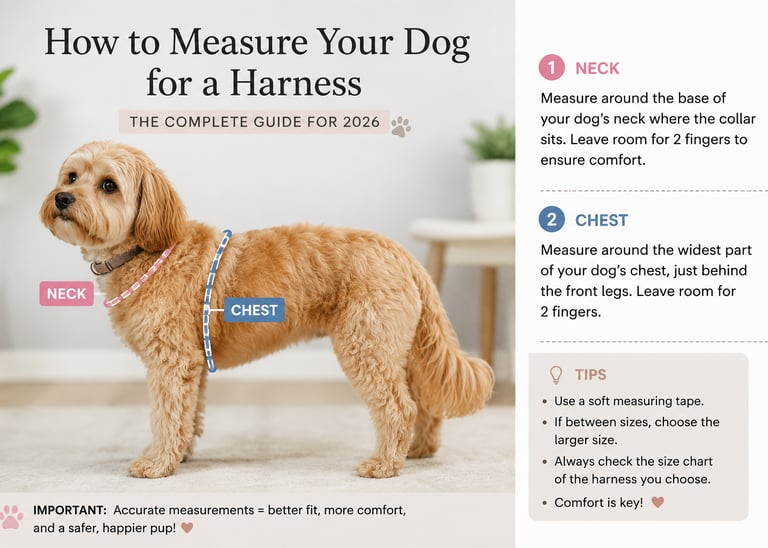
This is the measurement that matters most for harness sizing. The chest girth is measured around the widest part of your dog’s chest — typically right behind the front legs.
How to measure:
• Have your dog stand up straight on all four paws
• Wrap the measuring tape around the widest part of their chest, just behind the front legs
• Make sure the tape is snug but not tight — you should be able to slide two fingers underneath
• Write down the number in inches
This measurement determines your dog’s harness size more than anything else. Most harness size charts are based primarily on chest girth.
2. Neck Circumference
The neck measurement is used for harnesses that have a neck opening your dog steps into or that goes over their head.
How to measure:
• Wrap the measuring tape around the base of your dog’s neck, where a collar would sit
• Again, keep it snug but comfortable — two finger rule applies here too
• Write down the number
Bonus Measurement: Body Length
For some harness styles — particularly vest harnesses or step-in harnesses — the body length is also helpful.
How to measure:
• Measure from the base of your dog’s neck (where the collar sits) to the base of their tail
• This helps ensure the harness body panel covers the right area
This is especially useful for Dachshunds and other long-bodied breeds who sometimes need a different size for length versus girth.
How to Read a Harness Size Chart
Once you have your measurements, every harness will have a size chart — usually listing chest girth ranges for each size (XS, S, M, L, XL).
Here’s a general guide for small breeds in 2026:
Extra Small (XS): Chest girth 10–14 inches — typical for very small Chihuahuas, tiny Yorkies under 4 lbs
Small (S): Chest girth 14–18 inches — typical for most Chihuahuas, small Yorkies, Toy Poodles
Medium (M): Chest girth 18–22 inches — typical for larger Yorkies, Shih Tzus, Miniature Dachshunds
Large (L): Chest girth 22–27 inches — typical for Cocker Spaniels, Miniature Schnauzers, French Bulldogs
Always check the specific brand’s size chart rather than relying on general guidelines, because sizing varies between manufacturers. If your dog falls between two sizes, size up for comfort.
The Two-Finger Rule: Your Best Friend
No matter what size you order, always do the two-finger test when the harness arrives.
Once the harness is on your dog, slide two fingers under any strap. If two fingers fit comfortably — not three, not one — the fit is correct. If you can fit more than two fingers, it’s too loose. If you can barely squeeze one finger in, it’s too tight.
This simple test works for the chest strap, neck opening, and belly strap.
Common Harness Fitting Mistakes (And How to Avoid Them)
Mistake #1: Measuring over thick fur
If your dog has a thick or fluffy coat, their measurements can vary significantly between grooming appointments. Always measure down to the skin level, or at minimum be consistent — always measure over the coat so your measurements are comparable to the size chart.
Mistake #2: Measuring while your dog is sitting
Always measure your dog while they’re standing. Sitting compresses the chest and can give you a smaller measurement than what you actually need.
Mistake #3: Ignoring the size chart
Every brand sizes differently. A medium in one brand might be an extra small in another. Always check the specific size chart for the harness you’re buying.
Mistake #4: Buying based on weight alone
Many pet parents look at weight guidelines on packaging and stop there. Weight is a rough guide but body shape varies enormously between dogs of the same weight. A Dachshund and a Chihuahua can weigh the same but need completely different harness sizes. Always use actual measurements.
Mistake #5: Not adjusting after purchase
Most harnesses have multiple adjustment points. Once the harness arrives, spend a few minutes adjusting each strap properly. A harness that felt wrong at first can often be made perfect with proper adjustment.
Best Harness Styles for Small Dogs in 2026
Now that you know how to measure, here’s a quick breakdown of the most popular harness styles and which dogs they work best for.
Step-In Harnesses
Your dog steps their front paws into two loops, and you clip the harness on their back. Great for dogs who hate things going over their head. Easy to put on and take off.
Best for: Chihuahuas, Yorkies, nervous dogs who dislike over-the-head styles
Vest Harnesses
A panel of fabric covers part of your dog’s chest and back. Distributes pressure evenly across the chest rather than concentrating it on one point. Very comfortable for all-day wear.
Best for: Small breeds with delicate tracheas, dogs who pull, fashionable pups who deserve to look amazing.
No-Pull Harnesses
Have a front clip on the chest that redirects your dog when they pull. The pressure turns them back toward you instead of allowing them to pull forward. Much gentler than neck collars for dogs who pull.
Best for: Dogs who pull on leash, training, everyday walks.
Boutique Designer-Style Harnesses
Because your dog deserves to look good. These harnesses combine fashion and function — premium materials, stylish prints, and proper no-pull or vest construction.
Best for: Dog moms who refuse to choose between cute and functional.
How to Put a Harness On Your Dog Correctly
Even the perfect harness won’t fit right if it’s put on incorrectly. Here’s the right way:
For step-in harnesses:
1. Lay the harness flat on the ground in the open position
2. Have your dog step their front paws into the two loops
3. Bring the harness up and clip the buckle on their back
4. Adjust all straps using the two-finger rule
For vest/overhead harnesses:
1. Hold the harness open in front of your dog
2. Guide their head through the neck opening
3. Bring one front leg through each side opening
4. Clip any belly or chest straps
5. Adjust all straps using the two-finger rule
If your dog resists, use treats to make it a positive experience. Practice putting the harness on and off a few times without going for a walk so they associate it with treats rather than with the leash.
Quick Reference: Measurement Guide by Breed
Here are typical chest girth ranges for popular small breeds — use these as a starting point, but always measure your individual dog.
Chihuahua: 12–16 inches
Yorkshire Terrier: 13–18 inches
Toy Poodle: 14–17 inches
Shih Tzu: 16–20 inches
Dachshund (Miniature): 16–20 inches
Maltese: 13–16 inches
Pomeranian: 12–16 inches
French Bulldog: 18–24 inches
Cavalier King Charles Spaniel: 18–22 inches
Frequently Asked Questions
Q: My dog is between sizes — which should I choose?
A: Always size up. A slightly larger harness can be adjusted down with the straps. A harness that’s too small can’t be made larger and will be uncomfortable for your dog.
Q: How often should I remeasure my dog?
A: For puppies, remeasure every 4-6 weeks since they grow quickly. For adult dogs, remeasure every 6 months or after any significant weight change.
Q: Can I use the same measurements for a collar?
A: No — collar sizing uses neck circumference only, while harness sizing primarily uses chest girth. Always use the appropriate measurement for each type of gear.
Q: My dog has a barrel chest — what harness style works best?
A: Dogs with deeper, rounder chests (like French Bulldogs) do best with adjustable vest harnesses that have multiple adjustment points. Avoid step-in styles which can be difficult to fit on barrel-chested dogs.
Q: How do I know if my dog’s harness is causing discomfort?
A: Watch for rubbing or hair loss around the armpits or chest, reluctance to have the harness put on, or changes in gait. If you notice any of these signs, recheck the fit or try a different style.
Final Thoughts
Getting the right harness fit is one of the best things you can do for your dog’s comfort and safety. It takes about five minutes to measure, and it saves you from the frustration of returns and the guilt of putting your pup in something that doesn’t feel good.
Measure once, order confidently, and adjust when it arrives. Your dog will thank you with every comfortable, stylish walk.
Shop our collection of boutique no-pull harnesses and luxury dog accessories at Bad & Boujee Pets.
https://www.tiktok.com/t/ZP9FoV3vbTrW5-oQpeH
About the Author
Kim is the founder of Bad & Boujee Pets and proud dog mom to Chloe and Fendi. As a pet parent, content creator, and pet lifestyle enthusiast, she shares dog care tips, product recommendations, breed insights, and real-life experiences to help pet parents make informed decisions and give their dogs the happiest, healthiest life possible. Through Bad & Boujee Pets, Kim combines her love for dogs, fashion, and pet wellness to create helpful resources and stylish inspiration for modern dog families.
Bad & Boujee Pets
Bad & Boujee Pets is where style meets comfort for your pup.We create fashionable, high-quality accessories designed to turn heads on every walk.
As an Amazon Associate, we earn from qualifying purchases. Some links on this site are affiliate links, which means we may earn a small commission at no extra cost to you.
Contact
Join The Boujee Pack
hello@badnboujeepets.com
© 2026 All rights reserved.